Furnace Short Cycling: Why Your Furnace Keeps Turning On and Off (and How to Fix It)
On. Off. On. Off. Every few minutes, all evening, and the house never quite gets warm.
That pattern has a name: short cycling. And it’s not just annoying. A furnace that starts and stops constantly burns more gas, wears out its ignitor and blower years early, and in the worst case overheats its heat exchanger. The sooner you find the cause, the cheaper the fix.
The good news is that most causes are simple, and a few you can fix tonight. Here’s how to tell what’s going on with yours.
First, Is It Actually Short Cycling?
A healthy furnace on a cold day runs for 10 to 15 minutes at a time, three to five times an hour at most. On a mild November day it may run shorter and less often, and that’s normal.
Short cycling looks like this:
- Cycles of one to five minutes, over and over
- The furnace shutting off before the thermostat is satisfied
- Rooms that never reach the set temperature, or swing hot and cold
- A gas bill that climbed without a colder month to explain it
Grab your phone, time three cycles, and note how long the furnace runs and how long it rests. That number helps us as much as it helps you.
The Two Kinds of Short Cycling
There are really two different problems hiding under one name, and the pattern tells you which one you have.
The furnace runs a few minutes, makes heat, then shuts itself off. That’s a safety shutdown. Something inside is getting too hot, and the high-limit switch is cutting the burners to protect the heat exchanger. This is an airflow problem until proven otherwise.
The furnace lights, runs a few seconds, and quits before making any heat. That’s an ignition problem. The burners light and the control board doesn’t get confirmation that they stayed lit, so it shuts the gas and tries again.
Figure out which one you have before you touch anything.
7 Causes of Furnace Short Cycling, From Most to Least Common
1. A clogged air filter
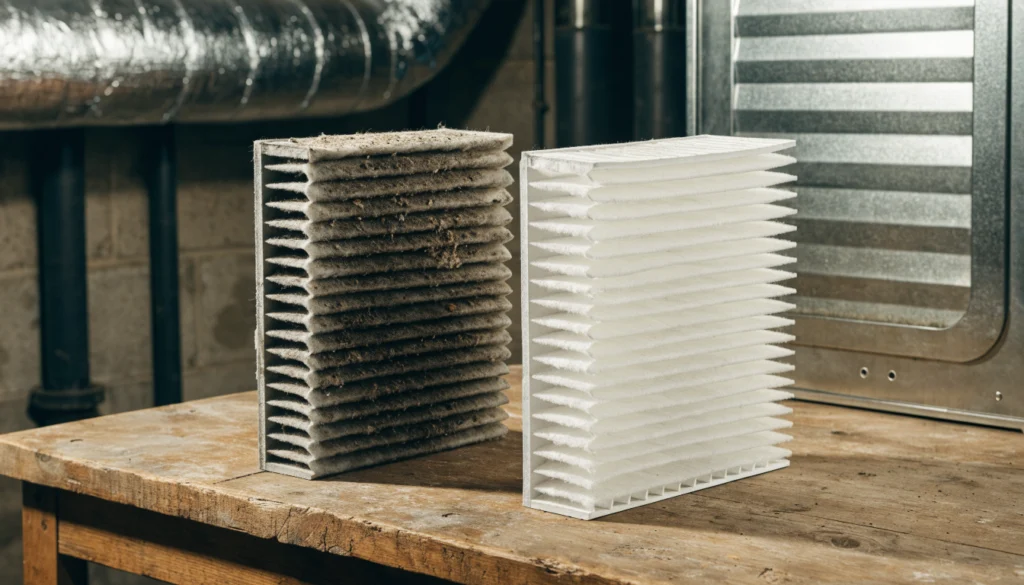
Still the number one cause we find. A dirty filter chokes the air moving across the heat exchanger. The exchanger overheats, the limit switch trips, and the furnace shuts down to cool off. Then it restarts and does it again.
Fix: replace the filter. Yes, even if it “doesn’t look that bad.” Then see our guide to how often to change it so you’re not back here in February.
2. Closed vents or blocked returns
Same mechanism, different cause. Supply registers shut in unused rooms, a dresser pushed over a return grille, or ducts crushed in the basement all restrict airflow and overheat the furnace.
Fix: open every register and clear every return. Closing vents to “save money” is a myth that costs money.
3. A dirty flame sensor
This is the ignition-type short cycle. The flame sensor is a thin metal rod that sits in the burner flame and tells the board “yes, we have fire.” When it gets coated with a film of oxidation, it can’t sense the flame, so the board cuts the gas after a few seconds. Light, quit, light, quit, lockout.
Fix: cleaning the sensor with a fine abrasive pad restores it in most cases. We’ll walk through that in an upcoming post. If you’re not comfortable in the burner compartment, it’s a short service call.
4. Thermostat location or settings
A thermostat in direct sun, above a lamp, or right next to a supply register gets fooled into thinking the house is warm. The furnace shuts off early, the room cools, and it starts again. Some thermostats also have a cycle-rate setting that’s been changed from the default.
Fix: compare the thermostat reading to a thermometer in the same room. Our thermostat troubleshooting guide covers the rest.
5. A failing blower motor or capacitor
If the blower is weak, it can’t move enough air to carry the heat away, so the furnace overheats even with a clean filter. Listen for a blower that’s slow to start, hums, or sounds strained.
Fix: technician. A capacitor is a cheap part; a blower motor is not, but both are far cheaper than the heat exchanger they protect.
6. A faulty limit switch
Sometimes the safety itself is the problem. A limit switch that’s drifted out of calibration trips at a lower temperature than it should, shutting down a furnace that isn’t actually overheating.
Fix: technician. We test the actual temperature rise across the furnace before we replace a limit switch, because a switch that trips correctly on a real overheat is doing its job.
7. An oversized furnace
The cause nobody wants to hear. A furnace that’s too big for the house heats the air near the thermostat so fast that it hits the set point in a few minutes and shuts off, long before the far rooms warm up. Then the thermostat drops a degree and it fires again. The house feels drafty and uneven, the bills are high, and the equipment wears out early.
Trane calls oversizing the most common cause of chronic short cycling, and we see it constantly in North Jersey homes that got a “bigger is safer” furnace during a replacement, or that added insulation and new windows after the furnace was sized.
Fix: there’s no repair for a furnace that’s too big. A two-stage or modulating thermostat setup can soften it. The real fix is a properly sized replacement, chosen with a load calculation instead of a guess. If your furnace is new and short cycling from day one, ask the installer for the Manual J calculation. If they can’t produce one, that’s your answer.
Why Short Cycling Costs More Than It Seems
Every start is the hardest moment in a furnace’s day. The ignitor heats to glowing, the inducer and blower motors spike, the heat exchanger expands from cold. A furnace built to do that four times an hour now does it fifteen.
Three things follow:
- Higher bills. A furnace is least efficient in the first minute of a cycle. Short cycles are all first minutes.
- Early part failures. Ignitors, flame sensors, and blower capacitors wear by the cycle, not by the year. We covered what that does to ignitor life.
- Heat exchanger stress. Repeated overheating and rapid expansion is exactly how metal fatigues and cracks. A cracked heat exchanger is the one furnace failure that’s also a carbon monoxide risk.
What to Do Tonight
- Replace the filter.
- Open every vent and clear every return.
- Check the thermostat against a thermometer and look for anything heating it.
- Time the cycles and note whether the furnace makes heat before it quits.
- Read the flash code on the control board if there is one. A limit-switch or flame-failure code narrows it fast.
If it’s still cycling after the first three, stop and call. Running a furnace that keeps tripping its limit switch is how a $200 repair becomes a replacement.
How We Diagnose It
A Perfection Contracting technician starts by measuring temperature rise: the difference between the air going into the furnace and the air coming out. Every furnace has a rated range printed on its data plate. A rise above that range means airflow is restricted; below it, the furnace is likely oversized or the blower is overdelivering. That one measurement separates the filter-and-duct problems from the sizing problems in about five minutes.
From there we check static pressure in the ducts, the flame sensor signal, the limit switch, and the blower. If the furnace is simply too big, we’ll say so, show you the numbers, and talk through options including a correctly sized furnace installation when the time is right.
Frequently Asked Questions
How many times should a furnace cycle per hour?
On a cold day, three to five cycles an hour of 10 to 15 minutes each is typical. More than six or seven short cycles an hour points to a problem.
Is furnace short cycling dangerous?
Not immediately, but repeated overheating damages the heat exchanger over time, and a cracked exchanger can leak carbon monoxide. Treat it as urgent, not optional.
Can a new furnace short cycle?
Yes, and when it does, the usual cause is that it was sized to the old furnace instead of to the house. Ask for the load calculation.
Furnace Won’t Stay On? Perfection Contracting Will Find Out Why
Short cycling is your furnace protecting itself from something. Find the something and the furnace goes back to running the way it should: long, quiet cycles and a house that stays warm.
Perfection Contracting provides 24/7 heating repair across Sussex County, Morris County and North Jersey. Call 973-579-0182 and tell us how long the cycles are. We’ll take it from there.