
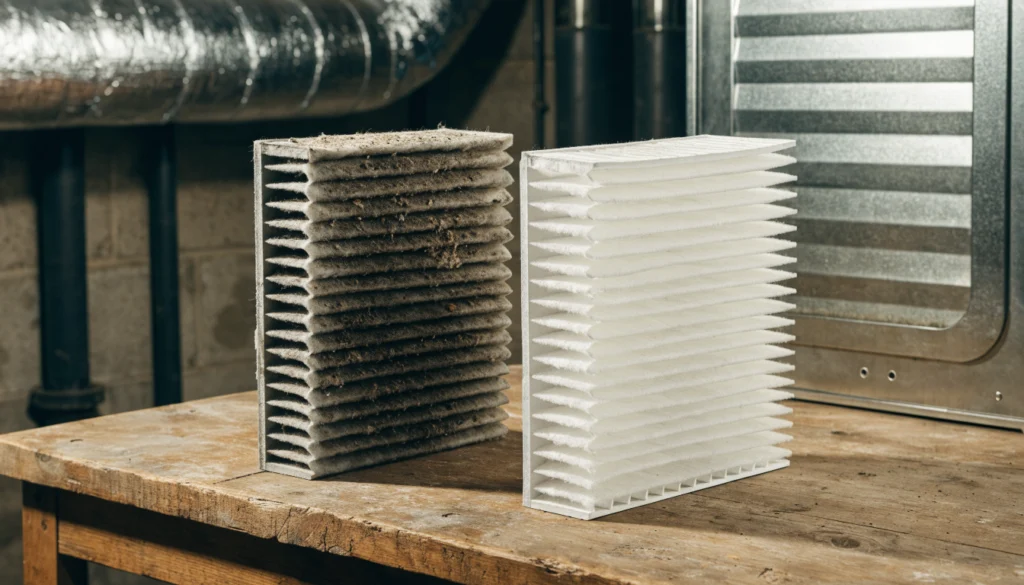
How Often Should You Change Your Furnace Filter? (Plus What MERV Rating Your Home Actually Needs)
Your furnace filter is one of the cheapest parts of your heating system, and one of the most important.
A clean filter protects the furnace, helps it run efficiently and improves the air you breathe. A clogged one makes the system work harder, can cause it to overheat and shut down, and lets dust circulate through the house.
So how often should you change your furnace filter? And what MERV rating does your home actually need? Here is a straightforward guide.
How Often Should You Change Your Furnace Filter?
It depends mostly on the thickness of the filter.
| Filter Type | Typical Replacement |
|---|---|
| 1-inch standard filter | Every 1 to 3 months |
| 2-inch filter | Every 2 to 4 months |
| 4- to 5-inch media filter | Every 6 to 12 months |
| Washable or electrostatic | Clean monthly per manufacturer |
Change it more often if you have:
- Pets that shed
- Allergies or asthma in the home
- Recent renovation or construction dust
- A large household
- Heavy heating use during cold snaps
The simplest rule: check it monthly during heating season. If it looks gray and dusty, replace it.
What Is a MERV Rating?
MERV stands for Minimum Efficiency Reporting Value. It rates how well a filter captures particles, on a scale that runs from 1 to 16 for residential and light commercial filters.
- MERV 1 to 4: Basic filters that protect equipment from large debris
- MERV 5 to 8: Good everyday filtration for dust, pollen and lint
- MERV 9 to 12: Better capture of finer dust and some pet dander
- MERV 13 to 16: High filtration for fine particles, smoke and some bacteria
What MERV Rating Do I Need?
For most homes, a MERV 8 to 11 filter is a good balance between filtration and airflow.
A MERV 13 filter can be worth it if someone in the home has allergies or asthma, or if you want better protection from fine particles. The EPA notes that MERV 13 or higher filters can capture smaller particles, as long as the HVAC system is designed to handle them.
That last part matters. Higher MERV filters are denser. In some systems, especially older furnaces with small returns and 1-inch filter slots, a high-MERV filter can restrict airflow. That can lead to:
- Reduced heating
- Higher energy use
- The furnace overheating and tripping its limit switch
- Frozen coils in summer with air conditioning
If you want higher filtration, a 4-inch or 5-inch media filter cabinet often gives you better filtration with less airflow restriction than a thick-rated 1-inch filter.
1-Inch vs. 4-Inch Furnace Filters
| Feature | 1-Inch | 4-Inch Media |
|---|---|---|
| Replacement frequency | Every 1 to 3 months | Every 6 to 12 months |
| Airflow at higher MERV | More restriction | Less restriction |
| Surface area | Small | Large |
| Upfront cost | Lower | Higher, may need a filter cabinet |
| Best for | Basic filtration | Better filtration and less maintenance |
Signs of a Dirty Furnace Filter
- The filter looks gray or caked with dust
- More dust on furniture than usual
- Rooms are not heating as well
- Higher heating bills
- The furnace runs longer or short cycles
- The furnace shuts off unexpectedly
- A dusty or burning smell from the vents
A clogged filter is one of the most common reasons a furnace overheats and shuts off. Our post on what a furnace limit switch actually does explains why.
How to Change a Furnace Filter
- Turn the thermostat off or set the system to off.
- Find the filter slot, usually where the return duct meets the furnace or behind a return grille.
- Note the size printed on the old filter frame.
- Slide the old filter out.
- Insert the new filter with the airflow arrow pointing toward the furnace.
- Close the access door and turn the system back on.
- Write the date on the filter frame.
Going Beyond the Filter
A filter is the first line of defense, but it is not the only way to improve indoor air in winter. Humidifiers, air purifiers and UV systems can all help when windows are closed for months.
Perfection Contracting offers indoor air quality solutions, including upgraded media filtration, for homes across North Jersey. We also check and replace filters during every heating service and maintenance visit.
Frequently Asked Questions
What happens if you never change your furnace filter?
Airflow drops, the furnace works harder, energy use rises, and the system can overheat and shut down. Over time it can shorten equipment life.
Is MERV 13 too high for my furnace?
Not always, but it can be for some systems with 1-inch filter slots and limited return airflow. A technician can tell you whether your system can handle it.
Can I run my furnace without a filter?
It is not recommended. Dust and debris can collect on the blower and heat exchanger and reduce efficiency and equipment life.
Which way does the furnace filter arrow go?
The arrow points in the direction of airflow, toward the furnace and away from the return duct.
Need Help Choosing the Right Filter?
If you are not sure what size or MERV rating your system needs, Perfection Contracting can help. Schedule heating service or call 973-579-0182.
Related Services
- Furnace Repair Service
- Furnace Installation
- Heating Services
- Heating Repair
- Heating Installation & Replacement
Keep Reading
- Why Does My Furnace Smell Like Burning? Normal First-Start Smells vs. Warning Signs
- How to Clean a Furnace: What You Can Safely Do Yourself and What Needs a Technician
Browse all HVAC tips and guides.
Need a technician? Perfection Contracting serves homeowners across Sussex County, NJ and the surrounding North Jersey service area.