
Let’s be honest.
If you’ve ever looked at the big unit outside your house and thought,
“Is that the compressor… or the condenser?” — you’re not alone.
We hear this question all the time.
And here’s the truth:
Most homeowners don’t fully understand how their AC system works — until something breaks.
That’s when confusion turns into stress… and sometimes, expensive mistakes.
So let’s fix that.
In this guide, we’re going to break down the real difference between an AC compressor and condenser — in plain English.
No technical jargon. No fluff.
Just clear answers that actually help you make better decisions.
Quick Answer: Compressor vs Condenser (Simple Explanation)
If you just want the short version:
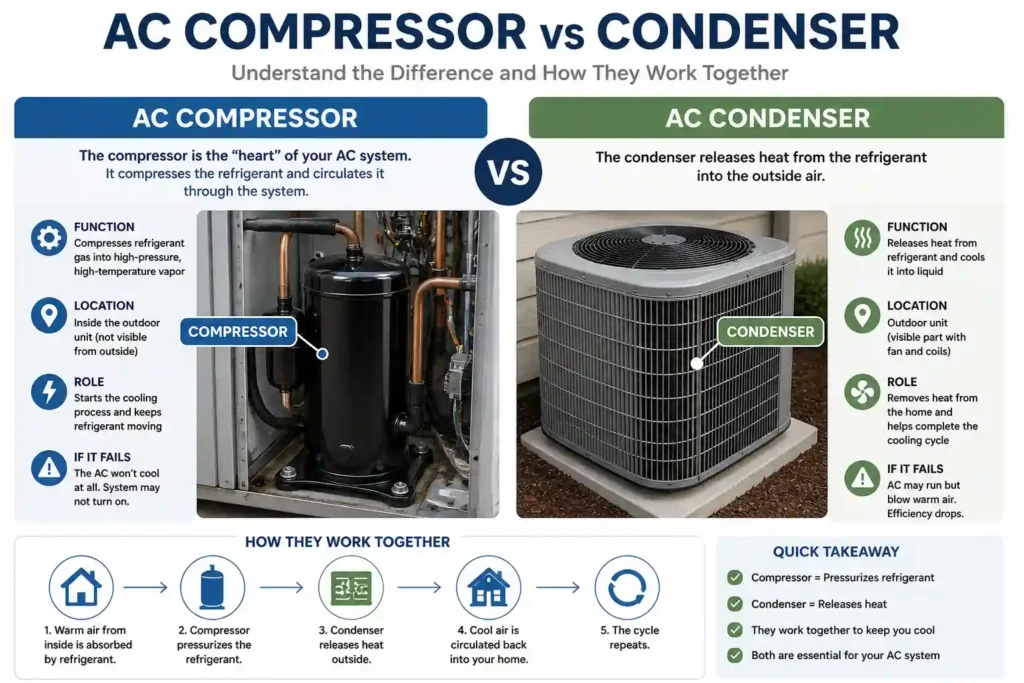
- Compressor = pressurizes refrigerant (the engine of your AC)
- Condenser = releases heat outside your home
That’s it.
But here’s where it gets important…
They don’t work separately.
They depend on each other to keep your home cool.
And when one fails, your entire system suffers.
What Is an AC Compressor? (The “Engine” of Your System)
Think of the compressor like the heart of your AC system.
It takes refrigerant gas and compresses it into a high-pressure, high-temperature state.
Without this step, the cooling process doesn’t even start.
Why It Matters
If your compressor fails:
- Your AC won’t cool at all
- The system may not turn on
- Repairs can be expensive
From what we’ve seen in real service calls, compressor issues are often the most costly HVAC repairs homeowners face.
What You Should Watch For?
Signs of compressor problems:
- Loud clicking or humming sounds
- AC running but not cooling
- System shutting off unexpectedly
What Is an AC Condenser? (The Heat Remover)
Now let’s talk about the condenser.
This is the part most people actually see — the outdoor unit with the fan.
Its job is simple but critical:
Release the heat your home doesn’t want — into the outside air
When the refrigerant enters the condenser:
- It cools down
- Turns from gas into liquid
- Prepares to cycle back inside your home
Why It Matters
If your condenser has issues:
- Your AC may still run… but blow warm air
- Efficiency drops
- Energy bills increase
Compressor vs Condenser (Side-by-Side Comparison)
Here’s the clearest way to understand the difference:
Feature | Compressor | Condenser |
Main Role | Pressurizes refrigerant | Releases heat |
Function | Starts cooling process | Finishes cooling process |
Failure Impact | System stops completely | Weak or no cooling |
Location | Inside outdoor unit | Outdoor unit (visible) |
Analogy | Engine | Radiator |
How Do They Work Together? (Step-by-Step)
Let’s simplify the full process:
- Your home’s air gets warm
- Refrigerant absorbs that heat
- Compressor pressurizes the refrigerant
- Condenser releases the heat outside
- Cool air cycles back into your home
And then… It repeats.
This cycle runs constantly during hot days.
Why Do Homeowners Get Confused? (And It’s Not Your Fault)
Here’s where things get tricky.
Most people think:
- The outdoor unit = condenser
- Or worse… the fan = compressor
Even in forums like Reddit, this confusion comes up constantly.
The truth is:
The entire outdoor unit is often called the condenser unit
But inside it… is the compressor
So technically, both are correct — depending on how you’re using the term.
That’s why HVAC terminology can feel confusing.
Common Problems: Compressor vs Condenser
Let’s break down what usually goes wrong.
Compressor Problems
These are more serious:
- Refrigerant issues (very common)
- Electrical failures
- Overheating
- Wear and tear over time
Condenser Problems
These are often preventable:
- Dirty coils
- Blocked airflow
- Fan not working
- Debris buildup
In our experience, dirty condensers are one of the most overlooked issues homeowners ignore.
Which One Is More Expensive to Fix?
Let’s talk numbers — because this matters.
- Compressor repair/replacement: $800 – $2,500+
- Condenser repair: $150 – $1,000+
- Full system replacement: $3,000 – $7,500+
Here’s the key takeaway:
Compressor problems are usually more expensive
Condenser issues are often maintenance-related
Can You Replace Just One?
Short answer: sometimes.
But here’s the honest answer we give homeowners:
- Replacing just the compressor or condenser can work
- But mismatched systems can reduce efficiency
- It may lead to future breakdowns
In many cases, replacing the full system is the smarter long-term move
Signs You Might Be Diagnosing It Wrong
This happens more than you think.
- AC not cooling ≠ always compressor failure
- Warm air ≠ always condenser issue
We’ve seen homeowners replace the wrong component… and still have the same problem.
That’s why proper diagnosis matters.
How to Prevent Compressor and Condenser Issues?
Here’s what actually works:
- Change your air filters regularly
- Schedule annual HVAC maintenance
- Keep the outdoor unit clean
- Make sure airflow isn’t blocked
Frequently Asked Question
Is the compressor inside the condenser?
Yes. The compressor is located inside the outdoor condenser unit.
Can an AC run without a compressor?
No. The compressor is essential for cooling.
Is the outdoor unit the condenser?
Yes — but it also contains the compressor and other components.
Which one is more important?
Both. One can’t function without the other.
When You Should Call a Professional?
Some problems shouldn’t be DIY.
Call an expert if you notice:
- Burning smells
- Electrical issues
- Loud or unusual noises
- AC not cooling at all
These can be signs of serious system failure.
Why Does This Actually Matters?
Understanding the difference between a compressor and condenser isn’t just technical knowledge.
It helps you:
- Avoid misdiagnosing problems
- Save money on unnecessary repairs
- Make smarter decisions about your HVAC system
And when something goes wrong, that knowledge makes a big difference.
Need Help Diagnosing Your AC?
At Perfection Contracting Inc., we’ve worked with homeowners who faced this exact confusion.
We don’t just fix systems.
We help you understand what’s really going on — so you’re not guessing, overspending, or making the wrong call.
Because when it comes to your comfort…
clarity matters just as much as the repair.
Related Services
- Cooling Services
- Air Conditioning Repair
- Air Conditioning Installation
- Air Conditioning Maintenance Service
- Ductless Mini-Splits
Keep Reading
- 15 Reasons Your Furnace Won’t Turn On (And How to Fix It Fast)
- HVAC Installation Services Near Me: What to Expect
Browse all HVAC tips and guides.
Need a technician? Perfection Contracting serves homeowners across Sussex County, NJ and the surrounding North Jersey service area.