

Furnace vs. Boiler: Which Is Right for a NJ Home When It’s Time to Replace?
Your heating system is on its last legs. Maybe the tech said the word “cracked.” Maybe the repair quote made you flinch. Either way, you’re shopping, and the first fork in the road is furnace or boiler.
Here’s the thing most comparison articles won’t tell you: in a North Jersey home, your house has probably already voted.
We’ll explain what that means, lay out the honest trade-offs, give you 2026 cost ranges, and tell you when switching from one to the other actually makes sense. By the end, you’ll know which column you’re in.
The 60-Second Difference
A furnace heats air. A blower pushes that warm air through ducts to registers in each room. It’s called forced-air heat, and the same ducts carry your central air conditioning in summer.
A boiler heats water. A pump moves that hot water (or steam, in older systems) through pipes to radiators, baseboards, or tubing in the floor. It’s called hydronic heat. No ducts, no blower, no air moving around.
Both can run on natural gas, propane, or oil. Both come in standard and high-efficiency versions. The fuel isn’t the dividing line. The delivery system is.
Rule #1: Your House Has Already Voted
If you have ductwork, you have a furnace home. If you have radiators or baseboards, you have a boiler home.
Switching means building the delivery system from scratch. Running new ductwork through a finished house means opening walls and ceilings and giving up closet space for chases. Running new hydronic piping to every room is the same story in reverse. Either way, you can easily double the cost of the project.
So for most homeowners, “furnace vs. boiler” really means “replace what I have, or pay a premium to switch.” There are good reasons to pay that premium. We’ll get to them. But know that’s the decision you’re making.
Furnace vs. Boiler at a Glance
| Factor | Furnace (forced air) | Boiler (hydronic) |
|---|---|---|
| Upfront cost | Lower | Higher |
| Efficiency (AFUE) | 80% to 98% | 80% to 97% |
| Typical lifespan | 15 to 20 years | 20 to 30 years |
| Heat feel | Fast, can feel drafty and dry | Even, radiant, quiet |
| Air quality | Moves dust; needs filter changes | No air movement; no filter |
| Central AC | Shares the ducts | Needs a separate system |
| Noise | Blower noise | Nearly silent |
| Common failures | Ignitor, blower, heat exchanger | Circulator pump, zone valves, leaks |
What Each One Costs in 2026
National figures first, so you have a yardstick.
Furnace: This Old House, drawing on HomeAdvisor data, puts a new furnace at $1,600 to $10,000 installed, with an average around $4,800. Gas units sit in the middle of that range; high-efficiency condensing models that need new PVC venting and a condensate drain sit near the top.
Boiler: HomeYou’s 2026 guide puts boiler installation at $3,942 to $14,183, with an average around $7,126. High-efficiency condensing boilers average closer to $9,342. Those figures assume you already have radiators or baseboards; adding the piping is extra.
So a boiler typically costs a few thousand dollars more up front. Over a 25-year life that gap narrows, because the boiler may outlast a furnace by a decade. Your real number depends on the size of your home, the fuel, the efficiency tier, and what has to change in the venting. We quote every job after seeing the house, and financing is available on both.
Efficiency: Same Rating, Different Reality
Both furnaces and boilers are rated by AFUE, the share of fuel that becomes heat for your home. A 95 AFUE furnace and a 95 AFUE boiler burn fuel equally well.
The difference shows up after the heat leaves the equipment. Ducts leak. They run through cold attics, crawl spaces, and garages. ENERGY STAR has long estimated that a typical duct system loses 20 to 30% of the air moving through it to leaks and poor connections. Insulated water pipes lose far less.
That’s why, fuel for fuel, a boiler home often sees lower monthly bills than a furnace home with the same AFUE sticker. It’s also why we push duct sealing so hard on forced-air homes. Seal the ducts and the gap mostly closes.
Comfort: Radiant Warmth vs. Fast Heat
Ask anyone who grew up with radiators and then moved to a forced-air house. They’ll tell you the heat feels different.
Hydronic heat warms surfaces and the air around them evenly, with no blast and no draft. Rooms hold their temperature between cycles. Radiant floor heat, the premium version, is about as comfortable as home heating gets.
Forced air wins on speed. Turn the thermostat up and you feel it in minutes. It also moves air, which means it moves dust and pet dander, and in winter it tends to dry the house out. If that’s been your experience, our guide to whole-house humidifiers explains the fix.
Lifespan and Maintenance
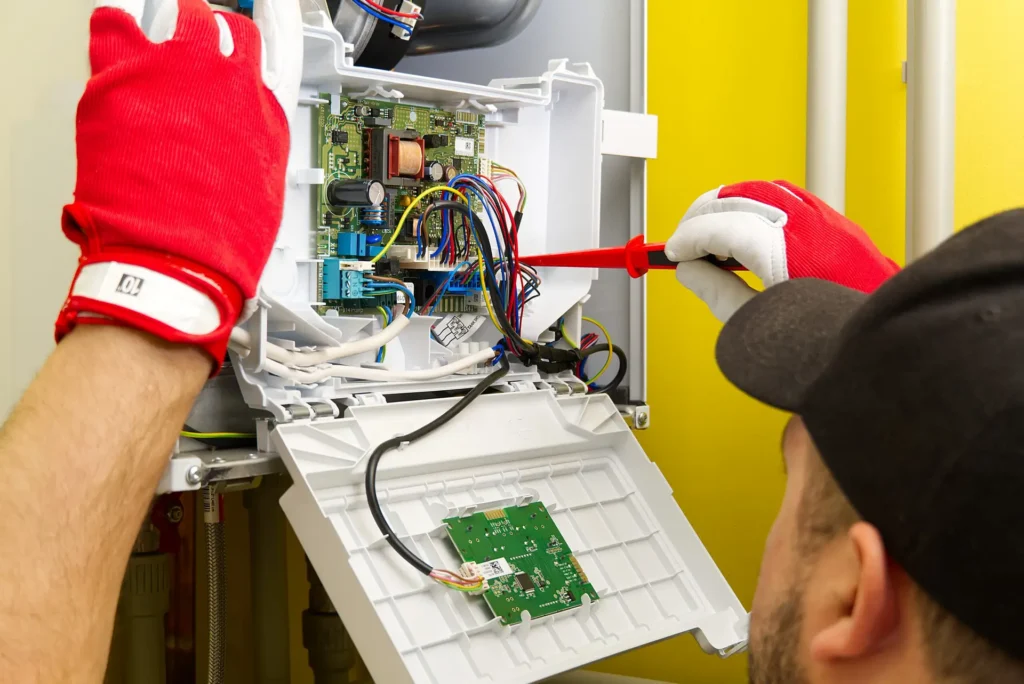
Furnaces typically run 15 to 20 years. The heat exchanger is the part that ends their life; once it cracks, replacement is almost always the right call. We covered the warning signs in our cracked heat exchanger guide.
Boilers commonly run 20 to 30 years, and old cast-iron units in Sussex County farmhouses sometimes go longer. Their weak points are the moving parts around them: circulator pumps, zone valves, expansion tanks, and the occasional leak. Those are repairs, not replacements.
Both need an annual service. A furnace also needs filter changes every one to three months. A boiler needs its pressure, vents, and water chemistry checked. Our boiler maintenance checklist and furnace tune-up guide spell out what each visit includes.
Three NJ-Specific Factors
Do you want central air?
This is the single biggest reason boiler homes switch to a furnace. If you’re adding ducts for AC anyway, a furnace rides along for a modest add-on. If you want to keep the boiler and still get cooling, a ductless mini-split system is usually the better answer than tearing the house apart.
Are you heating with oil?
A lot of older North Jersey homes run oil boilers. If gas is available at the street, replacement time is the moment to look at an oil to gas conversion. You keep your radiators, swap the boiler, and drop the tank.
Have you considered a heat pump?
Modern cold-climate heat pumps heat and cool through the same ducts. For a forced-air home, that’s a third option worth pricing. We explained how they hold up in cold New Jersey winters.
So Which One Is Right for You?
Replace with a furnace if: you already have ducts, you want central AC on the same system, you want the lowest upfront cost, or you’re considering a heat pump down the road.
Replace with a boiler if: you already have radiators or baseboards, you value quiet and even heat, someone in the house has allergies, or you want the longest equipment life.
Consider switching if: you’re doing a major renovation with walls open anyway, you’re adding ducts for AC, or your existing distribution system (pipes or ducts) is failing and has to be replaced regardless.
What a Good Replacement Quote Should Include
Whichever way you go, the equipment is only half the job. A quote that’s just a model number and a price is a red flag. Here’s what we put in writing on every furnace or boiler replacement.
- A load calculation. We measure the house, not the old unit. Oversized equipment short cycles and wears out early; this is true for boilers as much as furnaces.
- The venting plan. High-efficiency furnaces and boilers vent through PVC and need a condensate drain. Older chimneys often need a liner if a standard-efficiency unit stays on them. This is where surprise costs hide.
- What happens to the distribution side. Duct sealing or a return-air fix on a furnace job; a new expansion tank, air separator, or circulator on a boiler job. Small items that decide whether the new system performs.
- Permits and inspection. Required in New Jersey for both. If a contractor offers to skip them, keep shopping.
- Warranty terms in writing. Parts, heat exchanger, and labor, listed separately.
Ask for all five. A contractor who’s done this for a while will have them ready.
Frequently Asked Questions
Is a boiler cheaper to run than a furnace?
Often, yes, at the same efficiency rating and fuel, because hot water loses less energy in delivery than air in leaky ducts. A furnace home with well-sealed ducts closes most of that gap.
Can I replace a boiler with a furnace?
Yes, but you’ll need ductwork installed throughout the house, which is the expensive part. It makes the most sense when you’re adding central air at the same time.
Which lasts longer, a boiler or a furnace?
Boilers usually last longer, around 20 to 30 years versus 15 to 20 for a furnace, provided both are serviced annually.
Furnace or Boiler, Perfection Contracting Installs Both
The right answer depends on your house, your budget, and how you want your home to feel in February. We’ve installed both systems across Sussex County, Morris County and North Jersey for decades, and we’ll tell you honestly which one fits.
Call Perfection Contracting at 973-579-0182 for a replacement quote on a new furnace or boiler, or to talk through the switch if your house is ready for it.