Whole-House Air Purifier vs. UV Light: What Actually Cleans the Air When the Windows Are Shut
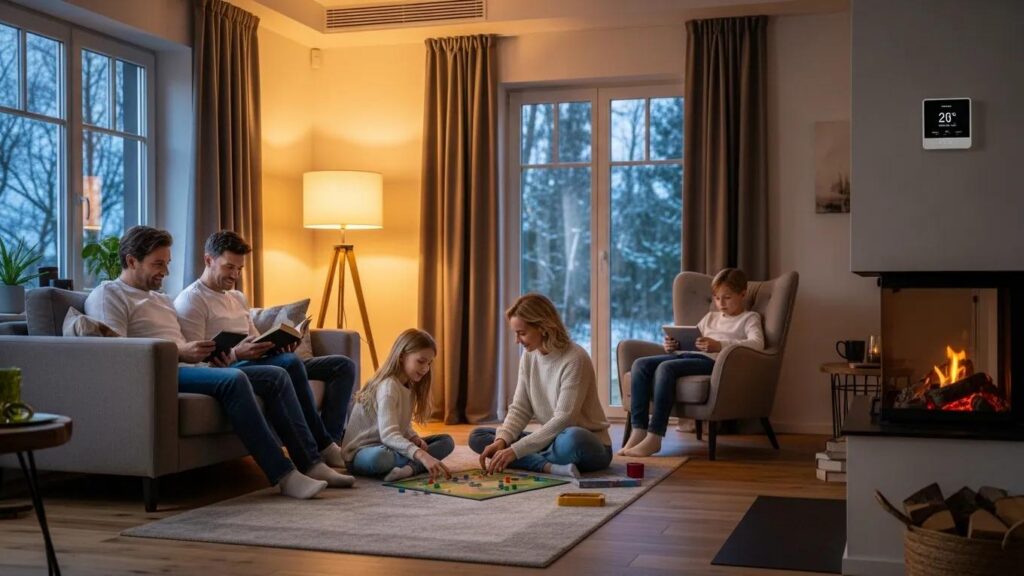
The windows have been closed for a month. Fourteen relatives are about to spend four days in your house, at least one of them coughing. And somebody just quoted you a “UV air purifier” for your furnace.
Is that the thing you need? Or is it the whole-house air purifier the last company mentioned? Are they the same thing?
They’re not. They do different jobs, they solve different problems, and a lot of the pages ranking for this question are written by companies that sell one of them. We install both, so here’s the version with no thumb on the scale.
Why Indoor Air Gets Worse in Winter
A sealed house is an efficient house. It’s also a house that holds onto whatever’s in it: dust, pet dander, cooking smoke, the off-gassing from a new couch, and every virus a guest brings through the door.
The EPA has reported for years that concentrations of some pollutants are often two to five times higher indoors than outdoors, and that Americans spend roughly 90% of their time inside. In winter, with no open windows to dilute anything, your furnace’s return duct is the only air cleaner you’ve got. A one-inch fiberglass filter is not up to that job.
Two Different Problems
Indoor air has two broad categories of stuff you don’t want to breathe.
Particles. Dust, pollen, dander, smoke, mold spores, the fine particulate from candles and the gas stove. These are physical things floating in the air. You remove them by catching them.
Biologicals. Bacteria, viruses, and mold growing on surfaces. These are living things. You handle them by killing them, or by catching them if they’re riding on a particle.
Once you see that split, the whole purifier-vs-UV question gets simple. One product catches. The other kills.
What a Whole-House Air Purifier Does
“Whole-house air purifier” is a broad label. In practice it means one of three things installed in your return duct, so every bit of air the furnace moves passes through it.
Media air cleaner
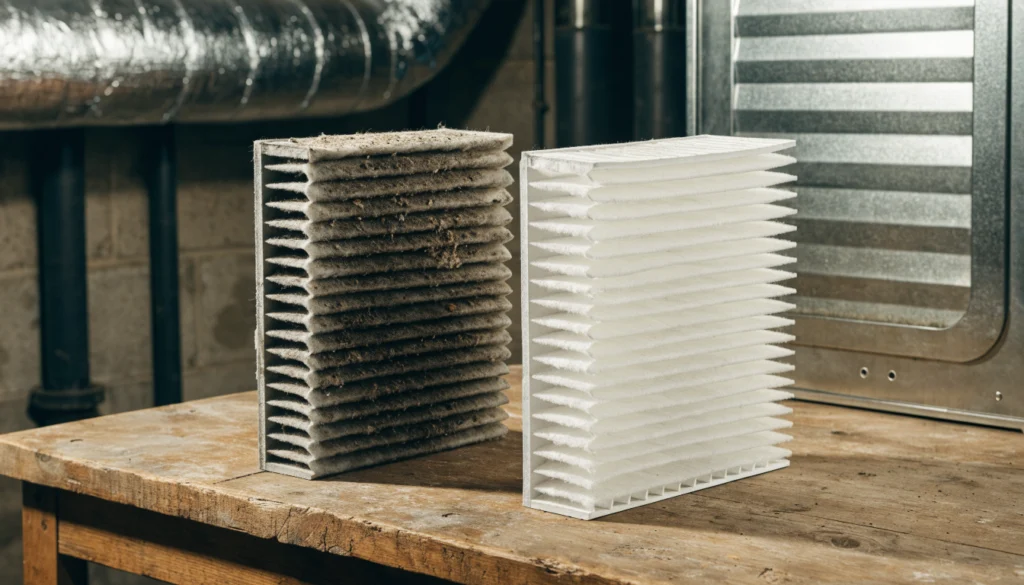
A deep cabinet holding a four- or five-inch pleated filter, typically MERV 11 to 16. Far more surface area than a one-inch filter, so it catches finer particles without choking airflow, and it lasts six months to a year. This is the workhorse. For most families with allergies, dust, or pets, it’s the single biggest improvement available.
Electronic air cleaner
Uses an electrical charge to make particles stick to collector plates or a charged media. Very good on fine particles like smoke. Some older designs produce a little ozone, which is a lung irritant; modern units are designed to avoid it, and it’s worth asking.
Whole-house HEPA
True HEPA filtration captures 99.97% of particles at 0.3 microns. It’s so restrictive that it has to be installed as a bypass unit with its own fan rather than inline in the return. The gold standard for severe allergies or asthma, at a higher price.
What none of these do: kill anything. A virus caught in the media is stuck there, which is fine. A bacteria colony growing on a damp coil is untouched.
A Quick Word on MERV Ratings
Every filter-based purifier is rated on the MERV scale, from 1 to 16 for residential products. The higher the number, the smaller the particle it catches.
- MERV 8: the standard one-inch pleated filter. Catches dust and pollen, misses most of what triggers allergies.
- MERV 11: adds pet dander and finer dust. A good baseline for homes with animals.
- MERV 13: captures smoke, smog, and many virus-carrying droplets. This is the level most indoor-air professionals recommend for a home with allergies or asthma, and it’s where a four-inch media cabinet starts to matter, because a one-inch MERV 13 filter restricts airflow too much for most furnaces.
- MERV 16 and HEPA: hospital-grade. Needs a system designed for it.
The trap people fall into is jamming a high-MERV one-inch filter into a furnace built for MERV 8. Airflow drops, the furnace overheats and short cycles, and the filter gets blamed. The fix is a deeper filter cabinet, not a thinner filter.
What a UV Light Does
An HVAC UV light is a germicidal UV-C lamp mounted inside your system. UV-C at 254 nanometers scrambles the DNA of microorganisms so they can’t reproduce. There are two very different ways to install one, and the difference matters more than the brand.
Coil-mounted (surface treatment)
The lamp shines continuously on the indoor coil and drain pan, the dampest spot in your HVAC system and the place mold and bacteria love. Because the light hits the same surface 24 hours a day, it works. Coils stay clean, the musty “dirty sock” smell goes away, and airflow stays up. This is the application where UV earns its keep.
Duct-mounted (air treatment)
The lamp sits in the ductwork and tries to zap microbes as air flies past. The catch is dwell time. Air in a residential duct moves fast, so each microbe gets a fraction of a second of exposure. UV dose is intensity multiplied by time, and the time is tiny. Manufacturers compensate with more lamps or higher output, and some units do post reasonable lab numbers, but a single duct lamp is not going to sterilize the air in your house. Anyone who tells you otherwise is selling a lamp.
What a UV light doesn’t do: remove a single particle. Dust, dander, pollen, and smoke pass right through the light untouched.
Side by Side
| Concern | Whole-house air purifier | UV light |
|---|---|---|
| Dust, pollen, pet dander | Yes, this is its job | No |
| Smoke and fine particles | Yes (MERV 13+, electronic, or HEPA) | No |
| Mold on the coil and drain pan | No | Yes, coil-mounted |
| Airborne viruses and bacteria | Captures those riding on particles | Partial, depends on exposure time |
| Odors and VOCs | Only with a carbon stage | No |
| Maintenance | Filter every 6 to 12 months | Bulb every 1 to 2 years |
| Operating cost | Filters only | Small, continuous electricity |
So Which One Do You Actually Need?
Match the product to your complaint.
“Someone’s always sneezing. The house is dusty two days after I clean.” Air purifier. A media air cleaner at MERV 13 or better solves most of this, and it’s the least expensive upgrade on the list.
“There’s a musty smell when the system kicks on, especially in summer.” Coil-mounted UV light. That smell is biological growth on the coil, and UV is the right tool for it.
“Asthma in the house. We get every cold that comes through.” Both, and in this order: media filtration or HEPA first, then UV at the coil. Filtration does most of the work; UV keeps the system itself from becoming a source.
“Cooking smells and the new-carpet smell won’t leave.” Neither, strictly. You want a purifier with an activated carbon stage, and better ventilation.
“I just want cleaner air and don’t know where to start.” Upgrade the filter first. Our guide to furnace filters and MERV ratings explains the sizing. If your system can take a four-inch media filter, that’s step one, and it may be the only step you need.
Three Things That Beat Both
Before you buy any equipment, check these. They’re cheaper and they matter more.
- Sealed ducts. Leaky return ducts in a basement or attic pull in dust, insulation fibers, and sometimes mold spores, then distribute them. Clean air through dirty ducts is a losing game. See our post on duct cleaning versus duct sealing.
- Humidity in the 30 to 45% range. Dry winter air lets viruses stay infectious longer and dries out your airways. A whole-house humidifier is often a bigger health upgrade than a UV lamp.
- Source control. Run the range hood. Skip the scented candles. Keep the garage door to the house closed. No filter beats not making the mess.
What to Ask Before You Buy
- For a purifier: what MERV rating, and can my blower handle the added resistance?
- For an electronic unit: is it ozone-free, and is that in writing?
- For UV: is it coil-mounted or duct-mounted, and what does the bulb cost to replace?
- For any of them: will it be installed where I can service it without calling you?
Frequently Asked Questions
Is a UV light for HVAC worth it?
Mounted at the coil, yes: it keeps the coil and drain pan clean and stops musty odors at the source. As a stand-alone “air purifier” in the duct, its benefit is limited by how briefly air is exposed to the light.
Do whole-house air purifiers remove viruses?
Viruses travel on droplets and particles, and high-efficiency filtration captures a large share of those. No home system removes every virus from the air, and filtration works alongside ventilation and humidity control, not instead of them.
Can I have both an air purifier and a UV light?
Yes, and for households with asthma or frequent illness, that combination is what we usually recommend: filtration in the return, UV at the coil.
Cleaner Air Before the Guests Arrive: Perfection Contracting Can Help
Catch the particles. Kill the growth. Keep the humidity right. Do those in that order and your house will breathe better all winter, guests or no guests.
Perfection Contracting‘s indoor air quality team installs media air cleaners, HEPA bypass systems, and coil-mounted UV lights across Sussex County, Morris County and North Jersey, and we’ll tell you honestly which one your house needs. Call 973-579-0182.