
You set your thermostat to 72°F.
A few seconds later, you hear the air conditioner start. Cool air begins coming through the vents, and eventually your Morris County home feels comfortable again.
But what actually happened?
Your air conditioner didn’t create cold air.
Instead, your central air conditioning system removed heat from inside your home, transferred that heat outdoors, removed some indoor moisture, and circulated the conditioned air back through your rooms.
Once you understand that simple concept, central AC becomes much easier to understand.
And for homeowners in Morris County, knowing how the system works can be especially useful.
Our area includes everything from older homes and renovated properties to large multi-level houses and newer construction. We regularly see comfort problems caused not only by the air conditioner itself, but also by airflow, ductwork, system sizing, additions, humidity, and how the HVAC system was originally designed.
So let’s walk through exactly how central air conditioning works and why each part matters in a Morris County home.
What Is Central Air Conditioning?
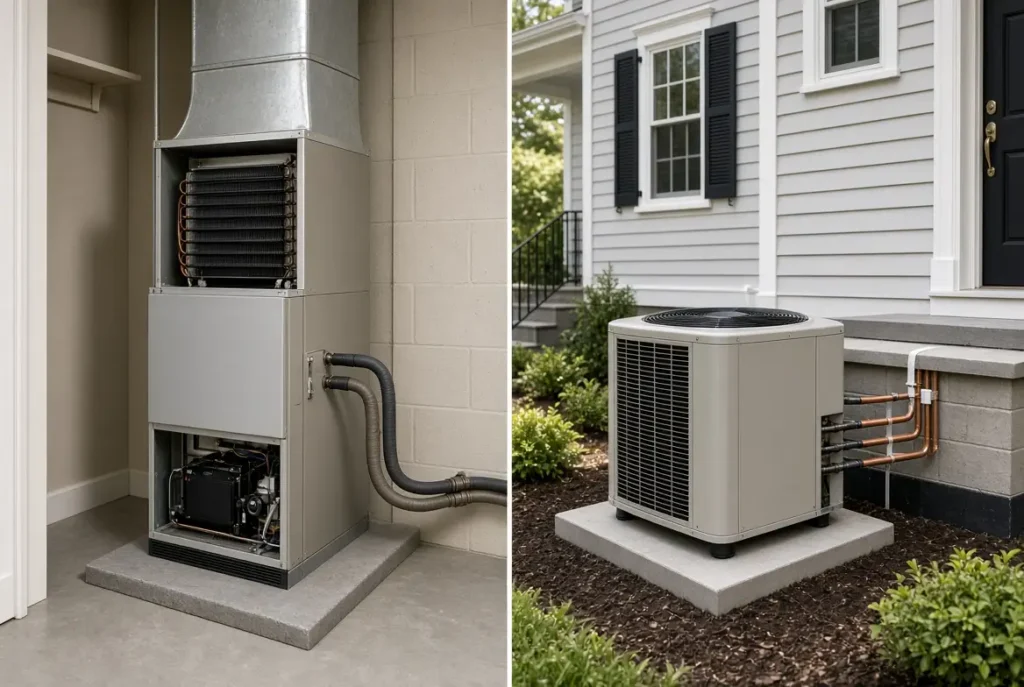
Central air conditioning is a system designed to cool multiple rooms, or an entire home, from one central HVAC system.
Instead of using individual window units in different rooms, central AC typically uses:
- A thermostat
- An indoor evaporator coil
- An air handler or furnace blower
- An outdoor condenser
- A compressor
- Refrigerant
- Refrigerant lines
- An expansion device
- Air filters
- Supply ductwork
- Return ductwork
Most central air conditioners installed in New Jersey homes are split systems.
That means the equipment is split between an indoor unit and an outdoor unit.
The indoor side handles heat absorption and airflow.
The outdoor side releases the heat your system removed from the house.
Here’s the simplest way to think about it:
Central AC doesn’t produce cold. It moves heat.
Now let’s follow that heat from your living room all the way outside.
How Does Central Air Conditioning Work?
The entire cooling process happens repeatedly while your air conditioner is running.
1. Your Thermostat Notices the House Is Too Warm
Everything begins at the thermostat.
Imagine you’ve set your thermostat to 72°F, but your indoor temperature climbs to 75°F.
The thermostat detects that your home needs cooling and sends a signal to the HVAC equipment.
Your blower starts moving air while the refrigeration system begins transferring heat.
The cooling cycle is now underway.
2. Warm Air Returns to the HVAC System
Before central AC can cool your house, it needs to collect the warm air already inside it.
That’s the job of your return-air system.
Return vents pull air from the living areas and send it through the return ductwork toward your HVAC equipment.
That air normally passes through an HVAC filter before reaching the cooling coil.
A clean filter helps keep dust and debris from collecting inside your equipment.
A badly clogged filter can restrict airflow.
When airflow drops, homeowners may notice:
- Weak air coming from vents
- Longer cooling cycles
- Certain rooms staying warm
- Higher energy use
- Ice forming around the evaporator coil
- More stress on HVAC components
This is one reason we always look beyond the outdoor AC unit when diagnosing cooling problems.
Sometimes the equipment can produce cooling just fine.
The problem is getting that conditioned air where it needs to go.
3. The Evaporator Coil Removes Heat From Indoor Air
Next, warm indoor air reaches the evaporator coil.
The evaporator is located inside the home, usually near the furnace or inside an air handler.
Cold refrigerant moves through tubing inside the coil.
As warm household air passes across the evaporator, heat moves from the air into the refrigerant.
The refrigerant gets warmer.
The air gets cooler.
It’s basic heat transfer, but it’s the heart of your air conditioning system.
The blower then sends that cooled air toward your supply ductwork.
But something else happens here that matters during a Morris County summer.
Your AC Also Removes Moisture
When warm, humid air passes over the cold evaporator coil, moisture in that air can condense on the coil.
Think about the water that forms on the outside of a cold glass during summer.
The same basic principle is happening inside your AC system.
That moisture collects and drains through the condensate system.
So a properly operating air conditioner doesn’t just reduce indoor temperature.
It also helps control humidity.
That matters because a 74°F house with excessive humidity can feel less comfortable than a properly dehumidified house at the same temperature.
4. Refrigerant Carries the Heat Outside
After absorbing indoor heat, the refrigerant carries that heat toward the outdoor unit.
This is one of the most commonly misunderstood parts of air conditioning.
Refrigerant isn’t simply a chemical that “makes cold air.”
Its primary job is heat transfer.
It circulates through the system, changing pressure and state as it:
- Absorbs heat indoors
- Carries that heat outdoors
- Releases the heat
- Returns inside to repeat the process
Under normal operation, refrigerant circulates within a closed system.
You shouldn’t need to routinely “refill” refrigerant like you fill a car with gasoline.
If the refrigerant level is low, the system should be inspected for a leak or another problem.
5. The Compressor Raises Refrigerant Pressure
The refrigerant now arrives at the outdoor condenser.
One of the most important components inside that unit is the compressor.
The compressor increases the pressure of the refrigerant vapor.
That process also raises its temperature.
Why?
Because we need the refrigerant to become hot enough to release its heat into the outdoor environment.
You can think of the compressor as the component that keeps the refrigerant moving through the cooling cycle.
Without it, heat absorbed inside your home couldn’t be effectively transported and released outdoors.
6. The Outdoor Condenser Releases Your Home’s Heat
Next, hot refrigerant moves through the condenser coil.
The large fan on the outdoor AC unit pulls or pushes outdoor air across that coil.
Heat moves from the refrigerant into the outside air.
That explains why the air coming from the top of an outdoor condenser often feels hot while the AC is running.
That’s a good thing.
You’re feeling heat that used to be inside your house.
After releasing that heat, the refrigerant begins making its way back toward the indoor system.
7. The Expansion Device Lowers Refrigerant Pressure
Before refrigerant can absorb another load of indoor heat, its pressure and temperature need to drop.
That’s where the expansion device comes in.
It regulates refrigerant flow and causes a pressure drop before the refrigerant re-enters the evaporator.
Now the refrigerant is ready to absorb heat again.
And the cycle repeats.
Evaporator → compressor → condenser → expansion device → evaporator.
It continues until your thermostat senses that the indoor temperature has reached its setting.
8. Your Ductwork Distributes the Cool Air
Cooling the air is only half the job.
Your HVAC system still needs to move that conditioned air throughout your home.
The blower pushes cooled air into the supply ductwork.
Supply ducts carry it toward bedrooms, kitchens, living areas, home offices, finished basements, and other conditioned spaces.
Meanwhile, return ducts continuously bring warmer household air back toward the HVAC equipment.
The airflow loop looks like this:
Room → Return Vent → Filter → Evaporator Coil → Blower → Supply Duct → Room
This is why ductwork matters so much.
Why Ductwork Matters in Morris County Homes?
A powerful air conditioner won’t guarantee comfortable rooms if the duct system doesn’t distribute the air properly.
ENERGY STAR estimates that a typical home can lose about 20% to 30% of the air moving through its duct system because of leaks, holes, and poor duct connections.
Imagine cooling 100 units of air but losing 20 or 30 of them before they reach the rooms you’re trying to cool.
That can lead to:
- Upstairs rooms that stay hot
- Weak airflow
- Long cooling cycles
- Different temperatures from room to room
- Higher energy costs
- Difficulty reaching the thermostat setting
ENERGY STAR notes that ducts located in places like attics, crawlspaces, garages, and unheated basements deserve particular attention.
That’s highly relevant when evaluating HVAC systems in Morris County.
We work with many different home layouts throughout communities such as Denville, Randolph, Morristown, Chester, Madison, Chatham, Montville, Mount Olive, and surrounding towns.
A home’s duct system needs to match the home it’s serving.
Home Additions Can Change How Central AC Performs

Here’s another problem we see with HVAC systems:
The house changes, but the HVAC system doesn’t.
Maybe a previous owner:
- Finished the basement
- Converted an attic
- Added a bedroom
- Built an addition
- Opened the floor plan
- Converted a porch
- Expanded the kitchen
- Changed room layouts
Now the AC system may be responsible for conditioning more space than it was originally designed to handle.
Perfection Contracting’s local Morris County service experience includes evaluating airflow issues, additions, renovations, multi-level properties, ductwork planning, and HVAC systems that need to be redesigned around changing home layouts.
That’s why an AC problem isn’t always solved by installing a bigger outdoor unit.
Sometimes the entire air-distribution system needs to be considered.
Why Bigger Isn't Always Better for Central AC?
This is one of the biggest misconceptions we hear:
“If my house isn’t cooling enough, I should just buy a bigger air conditioner.”
Not necessarily.
An oversized air conditioner can cool the temperature too quickly.
That may sound good, but rapid cooling can cause the system to shut down before it has run long enough to remove enough indoor moisture.
Frequent starting and stopping is known as short cycling.
It can contribute to:
- Uneven temperatures
- Poor humidity control
- More equipment wear
- Reduced comfort
- Higher operating costs
Proper AC sizing should account for more than square footage.
A professional evaluation may consider:
- Home size
- Insulation
- Windows
- Sun exposure
- Ceiling height
- Layout
- Air leakage
- Ductwork
- Building materials
- Number of occupants
- Existing HVAC equipment
That’s why we focus on matching the system to the house rather than simply installing the largest unit available.
What Does SEER2 Mean?
If you’re shopping for a central air conditioner in Morris County, you’ll probably see SEER2 ratings.
SEER2 stands for Seasonal Energy Efficiency Ratio 2.
It measures seasonal cooling efficiency under a standardized testing procedure.
Generally, the higher the SEER2 rating, the more efficiently the system can produce cooling under the test conditions.
However, buying a high-efficiency air conditioner is only one part of the equation.
Installation quality matters.
So do airflow and ductwork.
ENERGY STAR notes that poorly sealed duct systems can cause substantial efficiency losses, while sealing and insulating ducts can improve HVAC efficiency.
Think of it this way:
Buying efficient equipment but connecting it to poor ductwork is like buying a high-performance engine and putting it into a car with flat tires.
The system needs to work together.
Single-Stage, Two-Stage, and Variable-Capacity Central AC
Central air conditioners don’t all operate the same way.
Single-Stage
A traditional single-stage AC basically has two settings:
On and off.
When cooling is required, it operates at its designed capacity.
Two-Stage
A two-stage system can operate at a lower output when cooling demand is moderate and move to higher output when necessary.
That may allow for longer, steadier cooling cycles.
Variable-Capacity or Inverter AC
Variable-capacity equipment can adjust cooling output across a wider range.
Rather than repeatedly blasting at full capacity and shutting down, the system can more closely match the cooling needs of the home.
Depending on the house and system design, that may provide:
- More stable temperatures
- Longer cooling cycles
- Better humidity control
- Quieter operation
- Greater comfort
The right option depends on the house, budget, ductwork, comfort goals, and existing HVAC configuration.
What Morris County Homeowners Should Know About New Refrigerants?
Air conditioning technology is also changing.
The EPA’s current refrigerant transition rules affect newly installed residential HVAC systems.
As of 2026, a newly installed residential split system generally must use refrigerant below the applicable global-warming-potential limit. Existing R-410A equipment can still be repaired, and compatible components can continue to be manufactured and sold for servicing existing systems. However, those components cannot be combined to create a new R-410A system.
So if your current R-410A air conditioner still works, don’t panic.
You are not being forced to immediately replace it.
But if you’re shopping for a new central AC system in Morris County, refrigerant type is now an important part of the conversation.
Signs Your Central AC May Need Attention
Understanding how central air conditioning works makes it easier to spot problems.
Call for professional evaluation if you notice:
- AC runs but the house stays warm
- Weak airflow from vents
- One floor stays hotter than another
- Certain rooms never cool properly
- The AC starts and stops constantly
- Indoor humidity stays high
- Ice forms on the refrigerant line or evaporator
- Water appears around indoor HVAC equipment
- Utility costs suddenly increase
- Strange noises begin
- The outdoor unit won’t start
- The system runs almost continuously
These symptoms don’t all have the same cause.
For example, warm rooms could come from the equipment, duct leakage, poor air balancing, restricted airflow, system sizing, insulation, or several problems happening at once.
That’s why diagnosis should focus on the whole HVAC system, not just one component.
How to Help Your Central AC Work Better
You don’t need to become an HVAC technician to take better care of your system.
Start with a few basics.
Check Your Air Filter
A heavily clogged filter can restrict airflow.
Check it regularly and replace it according to the filter manufacturer’s recommendations and your home’s conditions.
Keep the Outdoor Unit Clear
Don’t let leaves, weeds, grass, or debris block airflow around the condenser.
Keep Supply and Return Vents Open
Avoid covering vents with furniture, rugs, curtains, or storage boxes.
Pay Attention to Changing Comfort
If a room that used to cool normally suddenly becomes uncomfortable, don’t ignore the change.
Have Ductwork Evaluated When Airflow Is Poor
Sometimes replacing cooling equipment won’t solve a duct-distribution problem.
Schedule AC Maintenance
Routine maintenance gives a technician an opportunity to inspect equipment operation before a small issue becomes a no-cooling call on a hot summer day.
Frequently Asked Questions About Central AC in Morris County
Does central air conditioning bring outdoor air inside?
Most conventional residential central AC systems primarily recirculate indoor air. Fresh-air ventilation can be handled separately depending on the HVAC design.
Does central AC remove humidity?
Yes. Moisture condenses on the cold evaporator coil while the air conditioner runs.
Where does the heat from my house go?
Your refrigerant absorbs the heat indoors and transports it to the outdoor condenser, where the system releases it outside.
Should refrigerant be added every summer?
No. A properly operating AC system circulates refrigerant in a closed loop. Low refrigerant may indicate a leak or another service issue.
Why is one floor of my Morris County home hotter than another?
Possible causes include duct design, air balancing, insulation, heat gain, restricted airflow, system sizing, or HVAC modifications made after additions and renovations.
Can I install central AC in an older home?
Often, yes. However, the best solution depends on whether suitable ductwork already exists and how much modification the house would require. In some homes, central AC works well. In others, ductless or a combination of systems may make more sense.
Is a larger air conditioner better?
No. Your AC should be correctly sized for the home’s cooling load. Bigger equipment can create its own comfort and humidity problems.
Central Air Conditioning Works Best as a Complete System
Here’s the main thing we want Morris County homeowners to remember:
Your central air conditioner is not just the box sitting outside your house.
It’s an entire system.
The thermostat tells it when to cool.
Return ducts collect warm air.
The evaporator removes heat and moisture.
Refrigerant carries heat outdoors.
The compressor moves the refrigerant through the cycle.
The condenser releases heat.
The blower and supply ducts deliver conditioned air throughout your home.
Every part affects the others.
That’s why problems like poor airflow, uneven temperatures, excessive humidity, or high energy costs aren’t always solved by replacing a single component.
At Perfection Contracting, Inc., we’ve been family-owned and operated since 1975, providing heating and air conditioning solutions throughout New Jersey. Our current service area includes Morris County, and our HVAC services include air conditioning installation, repair, ductwork, ductless systems, indoor air quality, heat pumps, and other comfort solutions.
Whether you’re trying to understand why one room never gets cool, deciding whether an older AC is worth repairing, or planning a new central air conditioning system for your Morris County home, the best solution starts by looking at how the entire system works together.
Because good air conditioning isn’t simply about making air colder.
It’s about moving heat, controlling humidity, delivering the right airflow, and keeping every room comfortable.
Related Services
- Cooling Services
- Air Conditioning Repair
- Air Conditioning Installation
- Air Conditioning Maintenance Service
Keep Reading
- Boiler vs. Furnace: What’s the Difference for NJ Homes?
- How to Fix Inconsistent Cooling in Your Home Without Major Renovations
- Is Geothermal HVAC Right for Your NJ Home?
Browse all HVAC tips and guides.
Need a technician? Perfection Contracting serves homeowners across Morris County, NJ and the surrounding North Jersey service area.